Here’s the field of Meggido, where it is said the Armageddon will happen. Currently, it’s farmland—- at the end of days, they say it’ll be the site of an epic battle where the Messiah will defeat the Antichrist. Today, at least, it’s pretty tranquil:

From the top of Mt. Gilboa (where King David lost a battle with the Philistines), you can see the fish ponds created when they drained the swamps of the valley below.

We also went to a lookout tower on Mt. Barkan. From there, we could see the borders to the West Bank, Lebanon, and Mt. Hermon since it was such a clear day. Here’s a picture of us waiting to go up into the tower.

I believe you can see the city of Jenin in the right-hand corner of this picture. It’s a part of the West Bank.

Fields on the Israeli side (and our tour bus!)

We then went closer to the Kinneret, or the Sea of Galilee. We visited a cemetery of some of the first pioneers (chalutzim) in the 20th century. Some of the most influential (and socialist) thinkers of the time were also buried there, such as Moshe Hess (friend of Karl Marx), but there are also poets such as Rachel the poet and Naomi Shemer (who wrote “Yerushalayim Shel Zahav,” or Jerusalem of Gold).
Moshe Hess

Naomi Shemer

Close to the cemetery was the Kinneret Courtyard, the school where the 20th century pioneers learned agriculture. We got a guided tour and watched a video about Rachel the poet.

We then went to the Arbel, a mountain area overlooking the Galilee and surrounding areas. (There are lots of mountains in the north of Israel, in case you couldn’t guess by now.)
Careful! Don’t fall off the mountain!

Looking down at a kibbutz nearby:

And the Sea of Galilee:

Right at the bottom of the mountain is a Bedouin village. Just like most countries in the area (like Jordan) with a Bedouin population, many have been encouraged to settle into a more permanent lifestyle. It’s a planned city, as you can tell:

As we were sitting on the mountain overlooking the Galilee, we talked about the water issue in the Middle East today. I learned that a major part of the peace agreements with Jordan in the ‘90s revolved around Israel supplying Jordan with a certain amount of water per year. Water is one of the few issues which, out of necessity, seem to bring talks closer around here.
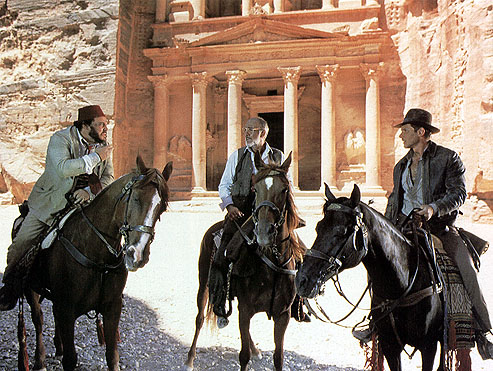
Speaking of which, spring break begins tomorrow!! I have finalized my itinerary, and I’m super excited. This weekend, I’ll be heading to Eilat with a few friends. From there, we’re going to walk across the border (legally!) into Jordan and go to Petra for the day! In case you were wondering, it’s also where they filmed part of "Indiana Jones and the Last Crusade."
I’m coming back to Haifa for Passover and the first night’s seder. I’ll be spending it at Ohr Chadash, the Reform synagogue close by (and also one of the few Reform synagogues in Israel). I think some of the service will be in English (yay!) and I’m also really curious about the Sefardic tradition, which involves being allowed to eat Kitniyot during the holiday, which Eastern European tradition does not.
On March 31, my roommate and I are going to Istanbul for 5 days! We’ll be there during Passover, Easter, and a Shiite holiday, so there will be a LOT of people there on vacation also. I can’t wait to learn more about the culture there and report back afterwards! So much sightseeing to do, so little time!
After we return to Israel (on Easter Sunday, no less!), I’m spending the rest of our 2.5-week spring break in Haifa. We might day-trip down to Tel Aviv at some point, but other than that we’ll be living in the dorms. That means I’ll also be here for my 21st birthday—after Passover, before school starts. It can’t get much better than this!
I’ll end with a few more flower pictures that I took on the trip this past Sunday. They’re not particularly relevant to our class, but I think they’re pretty.


No comments:
Post a Comment